
India's Muslims need to assert their educational and economic upliftment and political empowerment rather than be provoked by communal remarks, says Mohammad Sajjad, reflecting on the Malda riot.
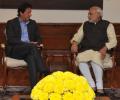
Pakistan's 'approach is one of getting even, an eye for an eye, or death by a thousand cuts.' 'The entire effort is to be the equal of India. Unfortunately, the reality is that this can never be the case.' 'India will always be the bigger, economically stronger, technologically more self-reliant country.' 'Therein, lies the dilemma Pakistan faces which leads it to perennial enmity with India,' notes Ambassador Gautam Bambawale in the Air Marshal Y V Malse Memorial Lecture 2019.

Dr Mitra called the Pandara Road crowd a 'cheerful collective of young dreamers,' united in its 'love and pride for the newly Independent India,' despite 'sharp disparities in background, temperament and attitude.' Dr Shreekant Sambrani recalls his encounters with the legendary economist who passed into the ages.

Considered a powerful player in Maldivian politics, former President Maumoon Gayoom on Thursday sought to allay India's concerns over rise of fundamentalism in Maldives by assuring strict implementation of a law to check radicalisation of Islam once his party returns to power.
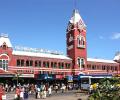
'Madras is a Tamil word while Chennai is Telugu. Without the English, there would have been no Madras. The erection of Fort St George laid the foundations for the growth of the first modern city of India,' Historian JBP More tells Shobha Warrier.

A former top envoy of the country questioned Pakistan's decades-old Kashmir policy.

Why, centuries after the French Revolution promised an end to feudalism, do political dynasties persist -- even in democracies, asks Ajit Balakrishnan.

'The verdict must be seen as something more; as a historical balm, a moral restitution and the deliverance of justice to a people wronged,' argues Vivek Gumaste.

'Had the BJP gone along with the NPP, that would have eased the task of the Congress of winning more seats.' 'That was a great strategy of the BJP.' 'It helped the NPP get more seats than perhaps if it had gone as a pre-alliance partner with the BJP.'

'His secularism merely declared the equality of all religions in India under fundamental rights.'

Ataturk and Nehru, two liberal secular modernisers, are in peril of being disowned by their successors, says Sunanda K-Datta Ray.
Stephen P Cohen pays tribute to strategic expert B Raman, who passed away recently.

Prime Minister Narendra Modi has met his match in Kanhaiya Kumar, noted writer Nayantara Sahgal has said as she praised the JNUSU president for his speech at JNU after his release from jail and his subsequent "rational" interviews to the media.
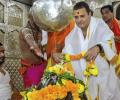
'If Rahul wants to pick up the sacred thread where his 'daadi' left it, especially when the BJP, which reduced his party to 44 in 2014, claims monopoly over Hinduism, it's smart politics.' 'Why cede your Gods to your rival?' asks Shekhar Gupta.
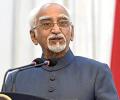
Delivering the 66th convocation address at the Panjab University, the vice president said a university should never seek to silence or influence faculty members or students to adopt or renounce any particular position.

'Nehru's hegemonic politics has been responsible for many ills, which undoubtedly includes Kashmir'


It would be a huge achievement if the new administration manages a successful transition to some sense of domestic and international normalcy in these frantic times marked by the pandemic and rise of illiberal regimes across the world, observes Shreekant Sambrani.
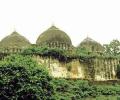
'People beat their chests when the Babri Masjid was brought down, not realising that it was just one event in a chain going back centuries; to look at the last link or two in isolation is absurd.'
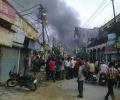
'If the BJP wants to build a minimally inclusive and secure society, in which vulnerable groups and religious minorities don't feel persecuted, then the Sangh Parivar, the party and its government must change their ways. Or else, they risk dividing India further -- violently and irreparably -- for narrow political ends,' argues Praful Bidwai.

'It is a great misfortune that the Nehruvian Stalinists of India have colluded with the grand project of demeaning and destroying Sanskrit. Today, the number of Sanskritists in India is low, and falling,' says Rajeev Srinivasan.

Four major political takeaways from Narendra Modi's much-anticipated trip to China
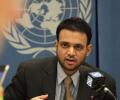
The 36-year-old desi speaks impeccable Arabic and quotes freely from the Quran during his speeches, reports Aziz Haniffa.

The Dalai Lama's Arunachal visit is not likely to derail the relationship but it is enough to signal the Chinese that India is also willing to flash the Tibet/Taiwan card should the need arise, says Sana Hashmi.
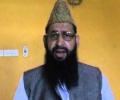
Muslim scholars on Friday trashed as "cheap publicity gimmick" and "childish" Bahujan Samaj Party leader Haji Yakub Qureshi's alleged statement hailing terrorists who truck at French satirical magazine Charlie Hebdo and demanded strict action against him.

'When Nawazuddin Siddiqui -- one of India's finest actors -- was told not to perform in a Ramleela, I realised how much Hinduism has been hijacked by Hindutva forces in the last 30 years,' says Syed Firdaus Ashraf.
The West has always preferred a timid, half intelligent and a dependent India rather than a decisively independent and self-reliant one. A pliable Indian leadership suits the West best, says Tarun Vijay.

Our Hindutva fanatics are actually making Hindu society more like Islamists are changing Muslim societies, says Shivam Vij.

The bench had made it clear that it would examine whether the practice of triple talaq among Muslims is fundamental to their religion.

'There is nothing wrong in accepting Rama as a God.' 'You will not get to read a story as deep as Valmiki's Ramayana in which he talks about complex relations, strong emotions, pain, desertion and unconditional love. Whether you depict Rama as a human being or a divine person, the Ramayana is an epic with a great human story.' 'It is not religious intolerance at all; this is part of political power and polarisation. A religious person will never act intolerant towards another religion.'
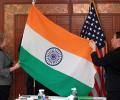
'My own Indianness has kept me evolving and changing -- and that's something that nobody and nothing can take from me,' says Roopa Unnikrishnan, who left the Indian shores a decade ago. As India gears up to honour its pravasis to mark their contribution in the nation's development, Rediff.com presents different perspectives on the Diaspora.
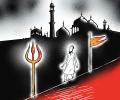
'Indian nationhood is indeed at the cusp of alarming redefinition -- hate-filled, and exclusionary.' 'Nations are not built this way, instead these are the ways of liquidating nations.' 'We must pre-empt it.' 'Can we?' asks Mohammad Sajjad.

The decision to introduce vastu shastra as a part of the architecture curriculum at IIT-Kharagpur has polarised architects in the country. Nikita Puri reports.

'Modi's visit is path breaking in the sense that India has come out of the closet and is prepared to deal with Israel openly and in a host of fields, military as well as civilian,' says P R Kumaraswamy, one of India's leading experts on the Middle-East, currently in Israel.
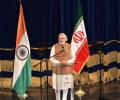
Invoking the age-old cultural bonds between India and Iran, Prime Minister Narendra Modi on Monday said it was time for the two countries to "march together" by regaining the "past glory" of historical ties
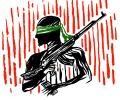
'It is important to destroy, to undermine, to debunk the narrative of ISIS,' Olivier Roy -- one of the world's leading experts on radical Islam -- tells Rediff.com's Vaihayasi Pande Daniel in an exclusive interview.

The prime minister, says Ram Kelkar, could do a lot to advance his stature as a national leader by speaking in strong and unequivocal terms on the subject of opposing intolerance and emphasizing the rule of law, thereby setting the tone for the nation and the party.

Can we make high speed 4G Internet available at 10 cents per GB, and make all voice calls free of cost -- that too in a large and diverse country like India? Can we make high-quality but simple breast cancer screening available to every woman, that too at the extremely affordable cost of $1 per scan? Can we make a portable, high-tech ECG machine which can provide reports immediately and that too at the cost of 8 cents a test? Can we make an eye imaging device that is portable, non-invasive and costs 3 times less that conventional devices? Can we make a robust test for mosquito-borne dengue, which can detect the disease on day 1, and that too at the cost of $2 per test? Amazingly, says Dr R A Mashelkar, the eminent scientist, all this has been achieved in India, not only by using technological innovation but also non-technological innovation.

'We are dealing with a size of the world that equaled England and France combined. We are talking about 250 years of history.' Sultans of Deccan India, 1500-1700: Opulence and Fantasy -- a first of its kind exhibition anywhere in the world -- opened at the Met, April 20. Aseem Chhabra spoke to Navina Haykel, the curator of the show.

On the occasion of the first prime minister Jawaharlal Nehru's 125th birth anniversary, Sheela Bhatt/Rediff.com visits his residence of 16 years, and comes away marvelling at his enduring legacy.
